Category Archives: Speculative Fiction
The Warden and the Wolf King Book Review – Part 3

I wrote about Leeli yesterday. But, today I want to finish with three truths I took away from the story. These may not be the messages that Andrew intended, but they are messages I took away from this wonderful story. So, what did the characters and the story of “The Warden and the Wolf King” teach me?
Evil does not always take on the expected form, particularly in the beginning.
Every good story must have a compelling and dangerous villain. From book one, I have been waiting impatiently to find out more about Gnag the Nameless. Try as I might, I could not imagine what Gnag looked like. He was not only nameless, he was faceless! Was he a reptile? Was he a wolf? Was he some other hideous manifestation of animal/man crossover?
I must confess, when I finally met Gnag the Nameless I was, well, underwhelmed. This was the creature responsible for an evil wave of Fangs overtaking the world? Really? Surely we can do better than this, Andrew. But, I trusted Andrew. I knew that the best villains are not necessarily the most vicious appearing villains. The best villains are subtle, almost ordinary, and certainly instill a sense of overconfidence in those who oppose such a villain. Hmm. Sounds remarkably similar to our own Enemy. He is subtle. He moves behind the scenes. And, he assumes a pleasing or nonthreatening appearance. But, he is NOT nameless!
Andrew does not disappoint in the area of bringing out the worst in Gnag. I cannot even begin to describe the events but there is no way any reader could ever be disappointed by Gnag’s ultimate plan and his ultimate appearance.
My take on this was how the Adversary works quietly behind the scenes in our lives. He places obstacles and crises in our way to trip us up. He throws his minions at our daily lives. We get frustrated, angry, and disillusioned and we often don’t even know why. The Adversary at this stage is truly nameless, faceless, and loving every minute of it. And then, through a glimpse of Truth through the eyes of Spirit, we see how Satan has tried to stop us from doing good. And now, in the light and in the open, the Adversary becomes the Beast that he is. And that is when we must choose — fight or flight — stand and engage in spiritual battle or run away and hide. Andrew has shown us that the fight can be intimidating and we can think we are losing but God will bring us the victory over an adversary who is already defeated! Thank you, Andrew for that insight.
The plan we have for our lives is not always the plan God has for our lives.
Kalmar did not want to be a king. He just wanted to indulge his artistic expression. This desire to avoid what others wanted him to do with his life led to his big mistake of singing the song that converted him into a wolf. Of course, being a wolf placed him in the desperate situation of fighting to retain his true identity and forced him into the very situation that led him to king like behavior. Andrew deftly and authentically shows Kalmar’s struggles in the final book. He takes Kalmar literally all over the place and through the story, Kalmar grows. Not only does he end up becoming the King, but his reluctance to be the king is the very thing that makes him a good king — the servant king.
In my own personal life, I know that God has taken me down paths I never imagined. Becoming an author, a dramatist, an apologist, and a public speaker was not in my plan. But, through the years of crises and refinement in the fire of depression, God has taken me to the place in life where I have found my purpose. And, in finding that purpose, I have found true joy. Unfortunately, the joy often comes at a price as we see in “The Warden and the Wolf King”. You just need to read it to see what I mean.
Running from God will leave us confused and unhappy and out of phase with the world. When we turn toward God along the path we have been avoiding, true fulfillment happens and we glimpse the eternal plan of God and see our place in it.
Janner just doesn’t want to be the warden. He doesn’t want to have to take care of his little brother. He wants to read. He wants to settle down in the huge library of ancient books; to get lost in the lines of poetry and essays and stories. And yet, in his desire for this we see his unease, his displeasure with a sense that everything is not quite right for him. He reluctantly takes on his role as warden with disdain and ultimately guilt. Of course, we see Janner’s brave protection of his brother in spite of his inner monologue of guilt and despair. And, ultimately it is Janner’s journey I most identified with.
Ultimately, we want to do God’s will for our lives and at times, we resent that. But, we know it is the good and right thing to do so we press on. And, in the perseverance, God begins to shape us and mold us into the person He intends us to be. Then there comes that moment, when our vision transforms from the momentary to the eternal and we see through God’s eyes the grand plan unfolding from the beginning of time and our place in it and we give in to that plan; we open our mind and our heart to the inevitable; we lose ourselves in the glory of His purpose with no regard for the price. And, in that moment we are most like Christ; a pale reflection in truth but still a connection with the sacrificial Lamb that is our salvation.
Thank you, Andrew for a wonderful tale that works on so many levels to convey Truth to a world drowning in the Adversary’s lies. I know that children (and adults) will enjoy this wonderful tale for a long, long time. And, I hope that we haven’t seen the end of the Jewels of Annieria.
To Find this book use this link.
For Andrew Peterson’s official book site this is the link. And Andrew’s personal site is here.
I gladly and with great anticipation received a copy of this book for this review. Readers of the first three books may feel appropriately envious!
Check out these other reviews of “The Warden and the Wolf King”:
Keanan Brand
Beckie Burnham
Pauline Creeden
Vicky DealSharingAunt
Carol Gehringer
Victor Gentile
Ryan Heart
Jason Joyner
Carol Keen
Krystine Kercher
Shannon McDermott
Meagan @ Blooming with Books
Rebecca LuElla Miller
Nissa
Writer Rani
Nathan Reimer
Chawna Schroeder
Jojo Sutis
Rachel Starr Thomson
Shane Werlinger
Phyllis Wheeler
And, if you would like to check out a special offer for my three books in the Jonathan Steel Chronicles, go to the order page at 11thdemon.com.
The Warden and the Wolf King Book Review Part 2
Bitter disappoint burned in my chest. I had just found out I was being released from my 5 book contract with Charisma after my second book. It was late on the first night of Hutchmoot 2012 and I wandered the beautiful grounds of Redeemer Church in Nashville crushed and weepy. I made my way back into the sanctuary to listen to our hosts regale us with song and sat on the last pew. In front of me, a young girl, probably 5 or 6 squirmed on the pew beside her mother, restless and bored. On the stage Andrew Peterson was about to sing a number from his newest album, “Light for the Lost Boy”. He told us this story:
An artist told about growing up without knowledge of God. But, somehow he knew there was Someone to watch over him, a secret Companion. Later in life, this man came to know Christ and realized that God was always with him in the quiet, desperate moments of his life. Andrew decided to write a song about this secret companion. Then, he paused and called out to his daughter. The girl on the pew in front of me snapped to attention and with great delight ran up to the stage to sing with her father. As they sang, “The Voice of Jesus” I wept silently with joy that even in the midst of my depression and disappointment, the voice of Jesus still whispered hope and love. When she joined in with her father at the end of the song, there wasn’t a dry eye in the room and a hushed, reverent stillness gripped us all. In that moment we heard not just the voices of Andrew and his daughter. We also heard the Voice of Jesus. My despair lifted and the music calmed my soul and brought me a measure of sorely needed peace.
I tell you this because when I read of Leeli in “The Warden and the Wolf King” I hear the voice of Andrew Peterson’s daughter raised in song. In fact, song and music are integral to the story of this novel and permeate throughout the narrative. This shouldn’t surprise me. Andrew Peterson’s songs are more than catchy tunes. They are deep, thoughtful reflections on our life in this imperfect world and the redemption we find in Christ’s love.
Song is so important to the story of “The Warden and the Wolf King”. I remember reading “Lord of the Rings” as a teenager and being impatient when I came to long verses of song lyrics. Most of the time, I skipped over them. And, although the songs’ words gave some framework for the world of Middle Earth, I could have done without them.
The Warden and The Wolf King Book Review — Part 1
I was sitting at an outdoor table under a tent with my son Sean when Andrew Peterson plopped down next to us and began to eat his dinner. It was a cool September evening in Nashville at the 2012 Hutchmoot. Talking to Andrew was like talking to a long lost friend. The conversation meandered to children, much like the three jewels of Annieria in the Wingfeather Saga. Andrew scrunched up his face, shoved his nose in my son’s face and proclaimed: “You better behave, Sean me boy, or your father’ll have you hoisted up the petard!”
I’m sure Andrew doesn’t remember this. He said things like that to everyone at Hutchmoot, but we remember it well. And, it is that spirit of random abandonment to reality that flows through the Wingfeather Saga.
Being a alumnus of two Hutchmoots, I can easily see in Andrew’s writing his love for Buechner, Lewis, MacDonald, Tolkien, and Wendell Berry. He blends elements of fantasy, swashbuckling, and allegory with a touch of parable throughout his works all set against a lushly realized landscape. Now, I am an author of a book series. I am currently in the final edit on book four and I can tell you it is not easy keeping all the story lines coherent and moving in parallel. One of my pet peeves is with authors who set out to write a book series and run out of creative energy early on. They create immersive worlds, stunning characters, and set up elaborate plot lines and then just get lost in their own maze. The list of book series I have given up on is long. By book four, you can tell you are lost in a forest along with the author and there is no way to get out unless you turn back (reboot your story) or open up the Pandora’s box of contrivances and let loose the deus ex machina.
Awake My Soul!
Summer is here along with the heat and humidity. I wrote in my last post that soon I will launching a website dedicated to depression and our new upcoming book, “Hope Again: A 30 Day Plan For Conquering Depression”. So, I dug through my previous posts and found this little story I wrote for the now defunct website, Posterous. It is set in the dead of winter, a reflection of the cold, dead feeling one can experience with depression. But, it is a story of hope!

Awake My Soul
I do not move.
I am quiescent and still.
Movement for me is pain. Life is pain.
The trees outside are harsh and bare. Winter has stripped them of vigor and life. Gray fingers claw at the even grayer sky. Even the clouds do not move. The air is still. No wind. No breeze. No life.
My daughter has placed me here on the porch. I feel the sting of cold on my cheeks but I can ignore it. I have ignored all feeling for months now. Since Tom died, I have had no reason to move.
My daughter has wrapped a scarf around my neck and tucked it into the woolen sweater Tom gave me last year for Christmas. I can still smell him on it when I choose to acknowledge my sense of smell.
The air is so cold, it numbs my face. The numbed is numbed even more.
“Why is she out there on the porch?” That is my son-in-law inside the warm house.
“I’m tired of her, Richard. I can’t take this anymore.” My daughter has tears in her voice. I cannot feel them. I cannot touch them. The tears mean nothing to me.
“She’ll freeze to death.” Richard says.
“That’s the idea.”
There is a profound silence. And then, subdued sobbing; quiet, subtle.
A white flake shimmies down the still air and lands on my nose. I choose not to feel it melt. So intricate, so beautiful in its design — one of a kind — it dies on my cold skin. It dies on the already dead. For, she has left me to die out here alone; cold; still; frozen.
The sliding door opens behind me and a waft of warm air bathes the back of my head. I cannot feel it on my neck for the scarf. Richard’s shadow falls over me from the lights inside the house; lights that try in vain to chase away the gray.
“You’ll have to forgive your daughter, Mom.” He says behind me. “She is very frustrated and wants to leave you out here to die.”
“I’m already frozen.” I whisper and he leans over me. His breath touches my forehead.
“Did you say something?”
“I’m already frozen.” I said more strongly. “Let me finish dying.”
My lips pull apart and I realize they have frozen together. I feel the pain as the first real sensation I have experienced in months.
Richard squats beside my wheelchair and for a second, I choose to notice the strong profile of his face; his angular cheekbones; his gently stubbled chin; his clear eyes. He is watching the trees.
“Winter is hard for all of us, Mom. Spring is coming. I want to tell you a secret. It is a deep and abiding secret that no one can know.”
More flakes are falling now and caressing my cheeks. I choose not to feel their gently touch. One lands on my cornea and I blink involuntarily. I must not do that again. But, try as a I might to ignore his statement, the attraction is there. What secret is he talking about?
“What secret?” My voice is a bare whisper.
“Virginia is stressed out because we have chosen to take a journey. It is a long and tedious journey and we will be gone for weeks. She doesn’t know what to do with you during that time. She can’t leave you alone. And, she isn’t going to leave you out here to die.” His breath streams away from him, a living thing full of warmth and moisture and the snowflakes eddy and swirl.
“Journey?”
“Rawanda. In Africa. There is a little girl. She needs a family.” He turns his head to me and his gaze is full and hot on my face. Tears mingle with the snowflakes. “She needs to know her grandfather. She needs to know what he was like. Only you can tell her that.”
Another snowflake hits my eye and melts. The moisture runs along my eyelid and I feel a hot tear trickle down my cheek. No! I cannot let this happen! I cannot feel!
“Will you come with us to Rawanda? Will you come with us to get your granddaughter?” His eyes are full and round and wet and the snow is covering his bare head, peppering his shoulders.
I feel something deep within stir from a slumber of unforgiving anger and frustration. The black dregs of my depression begin to drift away as the warmth stokes itself in my heart. No! I want to scream. No! I want to hold onto the stillness; the inertia; the coming of winter’s death. I try to ignore Richard’s gleaming eyes and his warm breath and when I subtly avert my gaze a flash of bright red burns my retinas. A lone flower dares to challenge the grayness from my camellia bush. The snow flakes are covering it now and it wants to be seen; it wants to look upward to the hidden sun for life and warmth; it wants to live.
The chair creaks; the ice breaks across my knees and I push, push, push up and out of the heaviness of my crypt of sorrow and I stumble to the flower. I brush away the snow with shaking hands and my tears anoint the petals with life. With life!
Awake my soul!
Awake!
I turn to my son-in-law who is standing with his mouth wide open and the snow covering his head and my daughter stumbles through the open door with her hands pressed to her tear streaked face and I feel the ice crack as I smile. “When do we leave?”
Don’t forget to pick up copies of “The Chronicles of Jonathan Steel” for your summer reading. You can go to the “Order” tab or check out 11thdemon.com.
Guest Post Laura K. Cowan
A week or so ago, I posted a blog sort of in answer to another blog post by a young, millennial atheist. Her blog is fascinating and necessary reading for anyone who professes to be a Christ follower, especially if you call yourself a “religious” person. Here is the link to her post: “This is Why We’re the Atheist Generation”. Well, I got slammed from well meaning “Christians” and from “atheists” who refused to return to the “manacles of the mind”. The comments came so fast, I decided to pull the post and regroup. But, there was one comment from a writer and novelist whose book I reviewed in the past. I asked her if I could post her comments as a guest blog. I find that her analysis of the current state of the church and its relationship to the twenty somethings out there is spot on. I asked if I could post her comments and I encourage every professing Christian and every church goer (whether a practicing Christian or not) to read her comments with a fresh mindset and respect. It gives us all great insight into what our “church” is doing wrong and what it is doing right in today’s world. I find it ultimately encouraging.

Millennials Leaving The Church: The Story of a Child of Evangelicals
Laura K. Cowan
for Bruce Hennigan 6/15/14
I am the child of Jesus People, radical hippy Christians, who were near-original members in a charismatic, evangelical church that grew out of an ecumenical Protestant-Catholic community in the Sixties. My parents lived in Christian communes with their friends, pooling their money, praying together with Catholics in a setting I didn’t realize was rare until I grew up (grateful for that example of unity), reaching out to the community around them to share their faith. Sounds a little weird but all right, doesn’t it? I think most people’s hearts were in the right place. I know a lot of wonderful people who came out of that movement.
An Old god . . .
My son, Sean, recently shared with me some thoughts on content and media in the wake of the introduction of a new game console. His insight into story and creating content are very interesting from the point of view of the twenty something generation. Here it is:
“every great thing that ever was, was small on the day before it became great” Michael Hyatt
The biggest problem we’re facing in the modern world is not hunger or disease, government overreach or corporate ownership, shifting global industries or climate change (though believe me, all those issues are important and vital to address in one way or another.) No, the biggest problem facing our generation is this: what do we do with the time we’re given?

We live in an unprecedented season of human history where technology, social development and worldwide prosperity gives an increasingly large portion of the world more free time than they know what to do with. Access to tools for information technologies and public information create a world where secrets can’t hide, and if they can, they can’t hide for long. Information access is the great socially destabilizing force of our time. When combined with the reshaping of world socio-economic systems, a larger population of the world’s population has access to a larger pool of comfortable free time than at any other point in human history.
Like Clay Shirkey points out in Cognitive Surplus, we’ve spent the last 50 years trying to reckon with this enormous shift in social and cultural life around the globe. Shirkey asserts that like the gin craze of industrialized London, society has coped with our influx of free time by investing in something easy and palatable (though by no means healthy): the television. We befriend characters (fictional and “real”) and we live vicariously through them, letting producers and writers take our nigh-genetically-encoded hunger for story and shared experience and transform it into a multimedia, multi-national conglomerate entertainment complex. For many years, television viewership was like a national religion – the shared set of stories and cultural understandings that grounded us in modern life.
But (and this is a really, truly crucial but): the world is changed. Ironically, the information access that created this coping mechanism’s key systems is also slowly dismantling it. With the advent of personal computing, interactive entertainment and affordable mobile electronic devices, people have more opportunity than ever to actively participate in and sometimes even co-create the media they consume. Smartphones enable users to photograph or record any event they choose; games like Minecraft and even Mass Effect allow users the opportunity to custom-tailor their story experience and tell stories of their own; and digital hosting like Youtube or Instagram allow for easy and free distribution of created material. We have participated in stories because we must be involved in shaping our understanding of our world; we have consumed them passively through commercial media production because previously we have had no choice.
We have participated in stories because we must be involved in shaping our understanding of our world
That has changed. Reality has shifted, and media creation (and participatory media consumption) is now within reach of (if not already a reality for) a vast majority of people in the developed world (and a good portion of the developing world too.) Humans have always had a nigh-infinite capacity for creation and self-realization; technology now allows our created works to finally catch up with our imaginations.

Most people realize that this change has come about on an instinctive level. They share photos and videos of their lives on Facebook; they post pictures to Instagram and keep up with far-flung acquaintances through digital audio and text. The capacity for deliberation and deep, honest engagement with people of like mind has never been greater. Therefore, for most people the television has become the new household god, a marker of cultural identity maybe, and a presence to which people feel great affection or deference, but not the overwhelming, monolithic driver of human existence and identity that it once was.
It’s an old god in a new world, having the appearance of power but slowly losing any of that power’s realities, not by outright defeat, but by a slow fade into irrelevance.
There’s a secret to that god, one that its fondest worshippers diligently spend millions of dollars a day to obfuscate and disguise. The secret is this: the god was never real, and was of our own making from the beginning. Before television, before commercial radio, we created: we told stories, we laughed at bars, we wrote songs on our porches. Sure, there were always consumptive media (and interactive experiences like games, incidentally), but we have always actively engaged them: we have gone to the theater, we have cheered at games, we have sung together in church. One of our human prerogatives is to create, and no amount of media consumption has ever fully suppressed that compulsion. We’ve consumed because we’ve been trained to; we create because we have no other choice.
So that’s my invitation to you: create. Make something. Do something; do anything. There is no amount of cultural gatekeeping that can keep you from creating. The tools are there; the desire is there. You need only to act. Michael Hyatt says every great thing that ever was, was small on the day before it became great. You have no idea how important your stories are: to you, to your loved ones, to me, to the world. You just have to tell them. If you do, if we create and share, then the world will never look the same again.
Summer is coming and you an find supernatural thrillers to read at the beach. Check out The Chronicles of Jonathan Steel and my newest book, “The 11th Demon: The Ark of Chaos” at the ORDER tab on this website.
We are Chimera!
Last night while sitting before my work computer I felt the gaze of a watching creature. I have written about evil and the supernatural lately, so perhaps this feeling echoed my latent paranoia. In the dark shadows behind my computer I noticed this object.
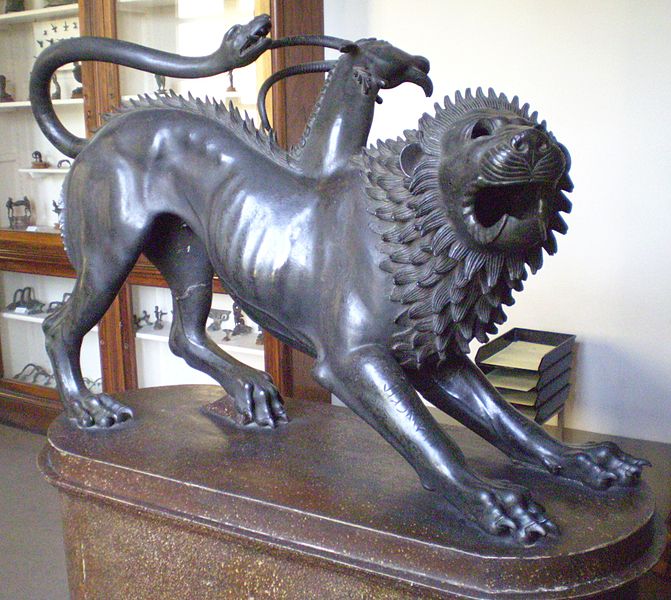
My reproduction of a famous sculpture recreates the mythical creature, the chimera. The beast has the head of a lioness, a serpent for a tail, eagle claws for feet, and a goat head protruding from its midsection. The chimera arose in Greek mythology as a monstrous fire breathing beast composed of many animal parts. Homer described the chimera in his Iliad as “a thing of immortal make, not human, lion-fronted and snake behind, a goat in the middle, and snorting out the breath of the terrible flame of bright fire.” The hypothesis about the origin of this myth refers to an area in southwest Turkey. Hikers on the “Lycian Way” encountered an area of over two dozen vents in the ground spewing forth flaming methane.
In modern times, the term chimera has come to represent a single organism composed of genetically distinct cells resulting in male and female organs, two different blood types, or subtle variations of form. This situation can occur in animals by organ transplantation such as a bone marrow transplant that can change someone’s blood type. in 1953, a human chimera was discovered to have blood containing two different blood types. Apparently this resulted from her twin brother’s cells living in her body.
You’re Just Being Paranoid!
I watched the sword impact with the woman’s neck and, thankfully, the news channel cut off the feed before it got too grisly. The newsfeed had originated from a soccer stadium on the other side of the world. I couldn’t breath and glanced over at my wife sleeping soundly in our hotel room bed for an afternoon nap. I quietly eased through the curtains and out onto the balcony. In stark contrast to the images of a real execution in Afghanistan I had just witnessed, the magical world of Disney’s California Adventure stretched out below me in the fading evening sun. My cell phone rang and I settled into a chair. My pastor was calling to see how our trip to California was going.
“Not too well, Mark.” I said. “It just seems that everyone I meet is so narcissistic, so self centered. It’s all about me, me, me. And, on live television I just witnessed a fanatic faction executing women in an arena for being caught in public with their ankles exposed. What kind of a world is this? I’m sitting here overlooking a Disney theme park in a state that is known for its self absorption and on the other side of the world crazy, fanatics are killing women because of a little exposed ankle flesh!”
“Well, I’m having a good day, too.” He answered sarcastically.
I went on to apologize for being so negative. And, I shared with him my growing sense of evil all around me. For weeks now, I had become increasingly enveloped by a cloud of oppression and despair the likes of which I had not felt since I went through my horrific depression years earlier. It was as if some great, unbound evil was coming preparing to pounce upon the world. I’ll never forget what I said next. “Mark, I think Satan is about to perpetrate a horrible evil on America unlike anything we have seen in decades and we are totally unprepared for the spiritual repercussions. God is trying to get our attention. And, the sad thing is, if something horrible happens the very person we will blame is God! And yet, we have escorted God right out of our daily lives and we will wonder how God let this thing happen.”
Something Evil This Way Comes!

I am an apologist. I don’t apologize for being a Christian. I defend the truthfulness of the Christian faith. The word “apologist” comes from the Greek word apologos. This word appears in the scriptures, 1 Peter 3:15-16. “But in your hearts revere Christ as Lord. Always be prepared to give an answer to everyone who asks you to give the reason for the hope that you have. But do this with gentleness and respect, keeping a clear conscience, so that those who speak maliciously against your good behavior in Christ may be ashamed of their slander.” That word “reason” is apologos and it means to give evidence as if you were defending yourself in court.
When we talk about the topic of evil, we have to consider the different types of evil. Fuz Rana from Reasons to Believe states: “Philosophers and theologians recognize two kinds of evil: moral and natural. Moral evil stems from human action (or inaction in some cases). Natural evil occurs as a consequence of nature—earthquakes, tornadoes, floods, diseases, and the like.”
Jonathan Steel — His origins
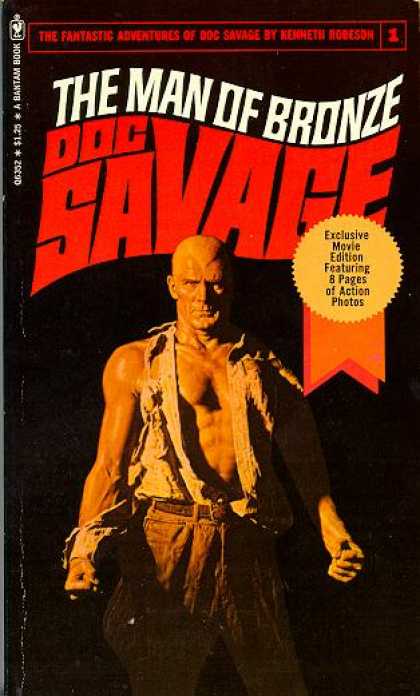 Very few people have heard of Doc Savage. Back in the 1930’s with the Great Depression covering the land with a dusty veil of hopelessness, magazines with serial stories provided an escape from reality. Long before Adolf Hitler procured the concept for his strategy of producing his master race, the idea that humanity could improve itself through eugenics promised a glowing future. Eugene Sandow considered the father of bodybuilding was a popular figure around the turn of the century. And, the hopes that through heredity, the human condition could be improved to the level of this astounding physical specimen lay behind the formation of many heroic figures in fiction at the time. This idea would later be called the “trans-human” effort to produce a superior human being.
History tells us how well that effort turned out! The pursuit of the eugenically perfect “super man” led to the Nazi holocausts and the horrors of World War II. But, long before the descent into darkness, the ability to perfect the human body fascinated the public. In response to Eugene Sandow’s popularity as the father of bodybuilding and this idea that perhaps the perfect human being could pull the world out of the Great Depression, a new fictional hero was born.
Publisher Henry W. Ralston and editor John L. Nanovic at Street and Smith Publications introduced the world to Doc Savage in March 1933. The series main writer, Lester Dent (under the pseudonym, Kenneth Robeson), wrote most of the 181 stories. Doc Savage’s real name was Clark Savage, Jr. and he was a physician, surgeon, scientist, adventurer, inventor, explorer, researcher, and a musician.

 Bruce Hennigan
You must be logged in to post a comment.